 Knights Templar
Egypt
Egypt was one of the principal powers of the eastern Mediterranean during the crusading period. Its rulers could draw on the farms of the Nile valley, a densely settled delta, Mediterranean ports and the revenues of Cairo. The Kingdom of Jerusalem faced Egypt across its southern frontier at Gaza.
The Fatimid court and Saladin
In the 1160s a struggle for control of the Fatimid government brought armies from Jerusalem and Syria into the delta. Amalric of Jerusalem campaigned there repeatedly. Saladin became vizier in 1169 and ended the Fatimid caliphate in 1171. Egyptian resources thereafter helped sustain his campaigns in Syria and Palestine. Under his successors the Ayyubid family ruled several territories, whose interests did not always coincide.
Why the crusaders came to the delta
On the Fifth Crusade, William of Chartres told the pope that taking Damietta would open a way to recover Jerusalem. The expedition ended with the Egyptians recovering the port in 1221. Al-Kamil later made a ten-year agreement with Frederick II over Jerusalem without surrendering Egyptian territory. In 1244, by contrast, the Templars worked with Muslim rulers in Damascus and Kerak against Egypt.
The end of Ayyubid rule
The Seventh Crusade reached Egypt during the last illness of al-Salih Ayyub. His household troops helped hold Mansurah, and the invaders surrendered in April 1250. His son Turanshah was killed before the king’s release. Under the Mamluk sultans, among them Baybars, armies and revenue raised in Egypt sustained the conquest of the remaining Frankish strongholds.
References
- William of Tyre, History, book XX. Chapter 24 identifies Philip as a former master and describes the king’s embassy. Chapters 31–32 recount the killing of an envoy and the dispute with Odo.
- William of Chartres to the pope, 1217. The Crusades Regesta, RRR 1767. October letter on provisions, mounts and the proposal to besiege Damietta.
- Frederick II and al-Kamil, truce of 1229. The Crusades Regesta, RRR 2098. The register identifies both Arabic and Frankish narratives of the agreement.
- Armand de Périgord to Robert de Sanford. Latin text in Matthew Paris, Chronica majora, ed. H. R. Luard, vol. IV, pp. 288–291. The printed p. 289 opens with the English preceptor’s name and office.
- Al-Maqrizi, al-Suluk, account of the crusade of Louis IX. The Egyptian historian compiled his account more than a century after the events. English translation in Chronicles of the Crusades (1848), reproduced by Fordham University. The editorial footnotes are distinct from the chronicle.
- The Templar of Tyre, Chronicle. Part III of Les Gestes des Chiprois, edited by Gaston Raynaud (1887). See §306 on the earlier captivity of Beaujeu and Gaudin and the entries for 1289–1291 on Tripoli, Acre and the remaining coastal towns.

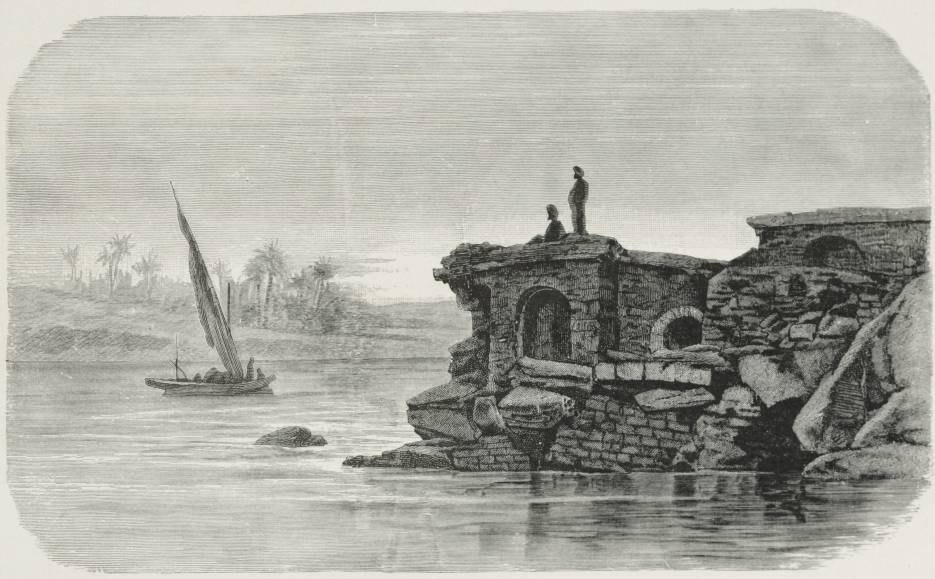
Illustration. F. C. Welsch, Travelers in the Middle East Archive. Original image and catalogue record. CC BY-SA 2.5. Resized for display.
