 Knights Templar
Seventh Crusade
The Seventh Crusade was the first expedition of Louis IX of France to the eastern Mediterranean. He sailed in 1248, occupied Damietta in 1249 and lost his army in the Egyptian delta in 1250. Four years passed between his release from captivity and his return to France.
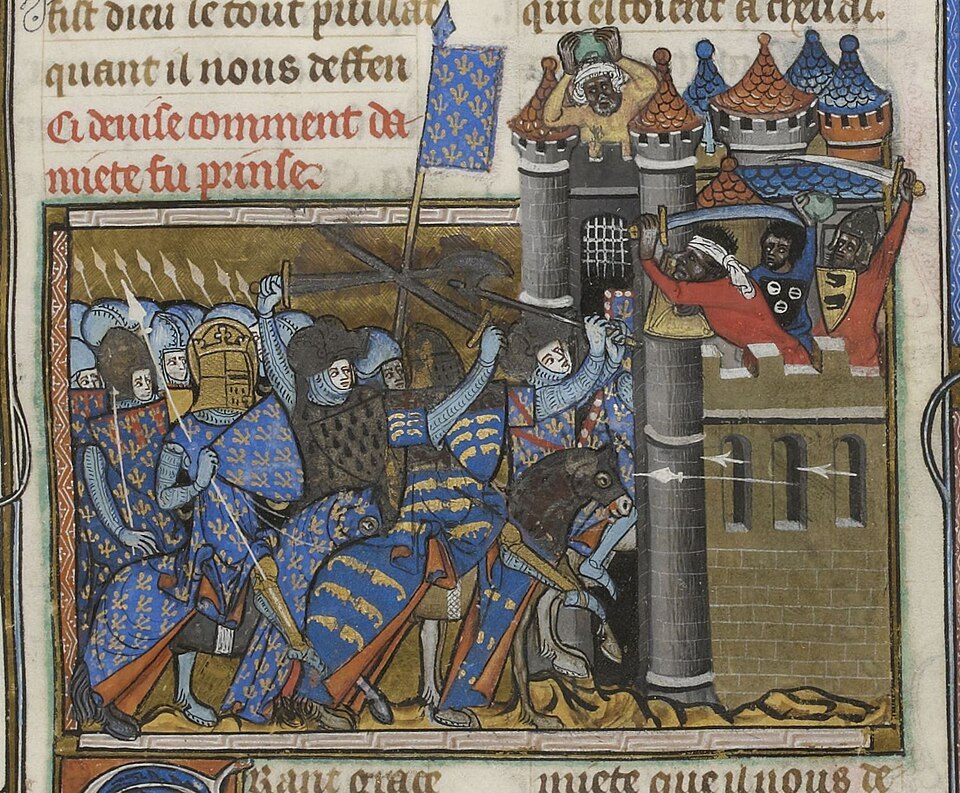
From Cyprus to Damietta
The army wintered on Cyprus, where provisions had been assembled before the king arrived. It sailed for Egypt in the spring. The French landed near Damietta in June expecting a fight for the city. Local troops withdrew, and many residents fled. Louis could enter the port within days. The river flood and the wait for reinforcements kept the army there through the summer. Supplies for the march south would have to follow it up the Nile.
The loss of the field army
At the Battle of Mansurah in February 1250, the king lost his brother Robert of Artois and the Templars lost their master, William of Sonnac. Egyptian successes on the river then cut off the French food convoys. The sick were placed on boats for the retreat in April. Soldiers on the banks and patients on the water fell into Egyptian hands in the same catastrophe. Louis surrendered at the Battle of Fariskur (1250). At Damietta, Margaret of Provence persuaded the remaining shipping interests to stay long enough for the city to be exchanged.
The years on the coast
Released in May, Louis sailed to Acre. He stayed to negotiate for captives and strengthen the towns still in Frankish hands, including Sidon. His insistence on directing foreign relations brought him into conflict with the master Renaud de Vichiers over independent Templar dealings with Damascus. Louis sailed home in 1254. His second expedition, in 1270, went to Tunis.
References
- Jean de Joinville, Life of Saint Louis. Translated by Frank Marzials. See the dedication on pp. 135–136, the departure on pp. 163–167, the fighting on pp. 188–203 and the account of captivity, release and the queen at Damietta on pp. 210–235.
- Jean de Joinville, Life of Saint Louis. English translation by Frank Marzials in Memoirs of the Crusades. See pp. 197–203 on Sonnac, 229–231 on the ransom and 263–265 on the Temple’s dealings with Damascus.
- Al-Maqrizi, al-Suluk, account of the crusade of Louis IX. The Egyptian historian compiled his account more than a century after the events. English translation in Chronicles of the Crusades (1848), reproduced by Fordham University. The editorial footnotes are distinct from the chronicle.
Illustration. Mahiet, Bibliothèque nationale de France. Original image and catalogue record. Public domain. Resized for display.
