 Knights Templar
Battle of Fariskur (1250)
The Egyptian defeat of the retreating army of Louis IX of France on 6 April 1250 ended the invasion that had begun at Damietta the previous June. The fighting and surrenders took place at several points on the Nile and its banks. The Egyptian chronicler al-Maqrizi places the hardest fighting at Fariskur.
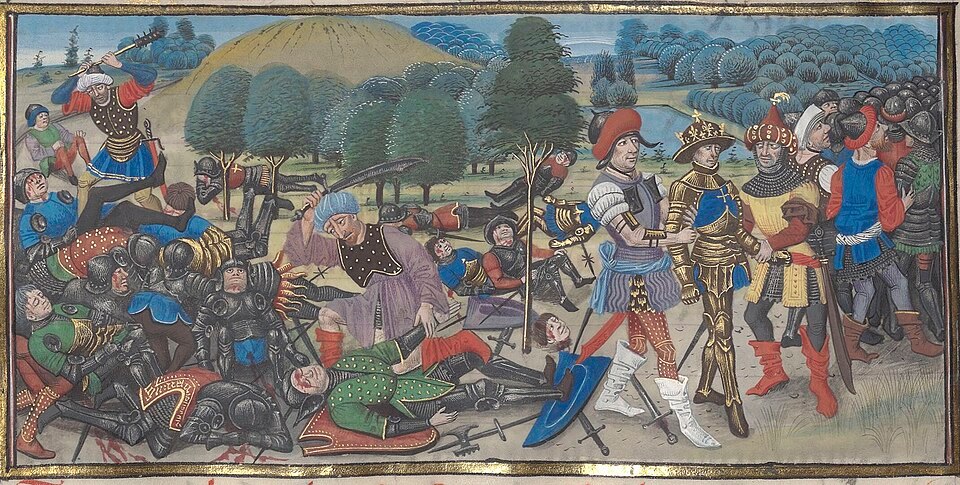
The retreat from Mansurah
Loss of the supply boats had left the camp near Mansurah short of food and full of sick men. Jean de Joinville described going downriver on a vessel carrying casualties while the king traveled by land. Egyptians overtook both groups. Joinville could tell how he became a prisoner and was separated from the sick aboard his boat. For the wider battle, al-Maqrizi gives sharply different casualty estimates even within his own account.
Damietta exchanged
The captured king was taken back to Mansurah. The French still held Damietta, and Louis could offer its return as well as money in exchange for release. The negotiations survived the murder of Turanshah of Egypt and the accession of Shajar al-Durr. Louis and a number of his companions eventually sailed to Acre. Many less prominent captives remained, and securing their release occupied the king well after his own departure.
References
- Al-Maqrizi, al-Suluk, account of the crusade of Louis IX. The Egyptian historian compiled his account more than a century after the events. English translation in Chronicles of the Crusades (1848), reproduced by Fordham University. The editorial footnotes are distinct from the chronicle.
- Jean de Joinville, Life of Saint Louis. Translated by Frank Marzials. See the dedication on pp. 135–136, the departure on pp. 163–167, the fighting on pp. 188–203 and the account of captivity, release and the queen at Damietta on pp. 210–235.
Illustration. Loyset Liédet. Original image and catalogue record. Public domain. Resized for display.
