 Knights Templar
Damietta
Damietta was the Egyptian port that two crusading armies occupied and twice had to surrender. It stood on the eastern branch of the Nile, close enough to the Mediterranean to receive seagoing fleets. From the port, smaller vessels could carry grain, animals and men into the delta.
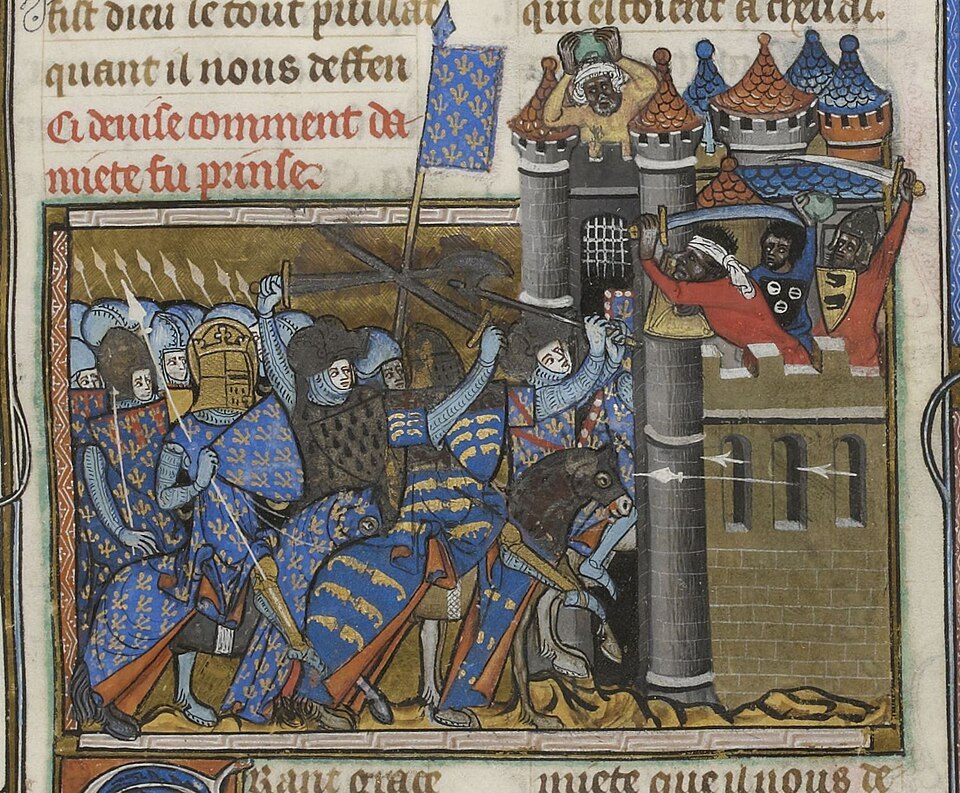
The long siege, 1218–1221
Before the Fifth Crusade sailed, William of Chartres described the choice facing the newcomers at Acre. Feeding so many men and finding enough horses for them was already a problem. Damietta offered a harbor and something to exchange for Jerusalem. The Siege of Damietta (1218–1219) nevertheless lasted into a second year. Once inside the walls the victors still depended on a river they did not control upstream. In 1221 Peter de Montaigu returned from the Egyptian campaign and wrote to England explaining why the surviving army had agreed to give back its prize.
The inhabitants and the second occupation
In June 1249 news of an Egyptian withdrawal spread through the town. Al-Maqrizi relates that inhabitants left their goods behind as they fled and that the news caused alarm in Cairo. The city passed to Louis IX of France almost immediately. A year later his wife Margaret of Provence was inside its walls when the king was captured. Food was short, and the merchants whose ships she needed threatened to leave. Jean de Joinville credits her with buying the available food and agreeing to feed them at royal expense. Holding the port long enough to hand it over became the condition for the king’s release.
References
- William of Chartres to the pope, 1217. The Crusades Regesta, RRR 1767. October letter on provisions, mounts and the proposal to besiege Damietta.
- Peter de Montaigu’s account of the withdrawal from Egypt, 1221. The Crusades Regesta, RRR 1886. Letter from Acre to the order in England after the surrender of Damietta.
- Al-Maqrizi, al-Suluk, account of the crusade of Louis IX. The Egyptian historian compiled his account more than a century after the events. English translation in Chronicles of the Crusades (1848), reproduced by Fordham University. The editorial footnotes are distinct from the chronicle.
- Jean de Joinville, Life of Saint Louis. Translated by Frank Marzials. See the dedication on pp. 135–136, the departure on pp. 163–167, the fighting on pp. 188–203 and the account of captivity, release and the queen at Damietta on pp. 210–235.
Illustration. Mahiet, Bibliothèque nationale de France. Original image and catalogue record. Public domain. Resized for display.
