 Knights Templar
Siege of Damietta (1218–1219)
The army of the Fifth Crusade besieged Damietta from May 1218 until November 1219. The port stood on an eastern branch of the Nile. To take it, the fleet first had to get past the defenses on the river, and then the army had to sustain itself outside a walled city through winter and another campaigning season.
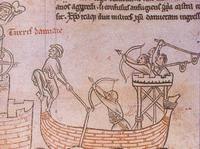
The tower and the city
A fortified tower in the river barred the approach to Damietta. Its capture in August 1218 opened the waterway without delivering the city. Egyptian forces remained nearby. John of Brienne and the military orders stayed with the siege through illness, interruptions in supply and changes among the commanders. William of Chartres died while the city still held out.
A grant written in camp
One record fixes the Templar succession more closely than a list of masters can. In the grant he made outside Damietta, Milo of Bar-sur-Seine named Peter de Montaigu as master. The act is dated August 1219. It assigned the order thirty pounds in annual income from France, and three witnesses are named at its close. A document drawn up over rents thus places four named men at the siege in a particular month and identifies the master recognized by the donor.
The consequences of the capture
The city fell in November. A dispute recorded by Peter the following year concerned how many soldiers could be spared from its defense for an advance inland. The feared separation of the garrison from the army came in 1221. Damietta was handed back to al-Kamil of Egypt while the Egyptian government still had the means to prevent that army from reaching the coast.
References
- William of Chartres to the pope, 1217. The Crusades Regesta, RRR 1767. October letter on provisions, mounts and the proposal to besiege Damietta.
- Milo of Bar-sur-Seine, grant to the Temple, August 1219. Latin text in Charles Lalore, Les sires et les barons de Chacenay, p. 222, note 3, citing Bibliothèque nationale, Français 5998, fol. 127v. The closing lines give the place, month and three witnesses.
- Grant to Peter de Montaigu at Damietta, 1219. The Crusades Regesta, RRR 1824. An August grant of rents identifies William’s successor during the siege.
- Peter de Montaigu to the bishop of Ely, 1220. The Crusades Regesta, RRR 1858. The master reports opposing views about leaving Damietta to advance into Egypt.
- Peter de Montaigu’s account of the withdrawal from Egypt, 1221. The Crusades Regesta, RRR 1886. Letter from Acre to the order in England after the surrender of Damietta.

Illustration. Matthew Paris. Original image and catalogue record. Public domain. Resized for display.
