 Knights Templar
Kerak
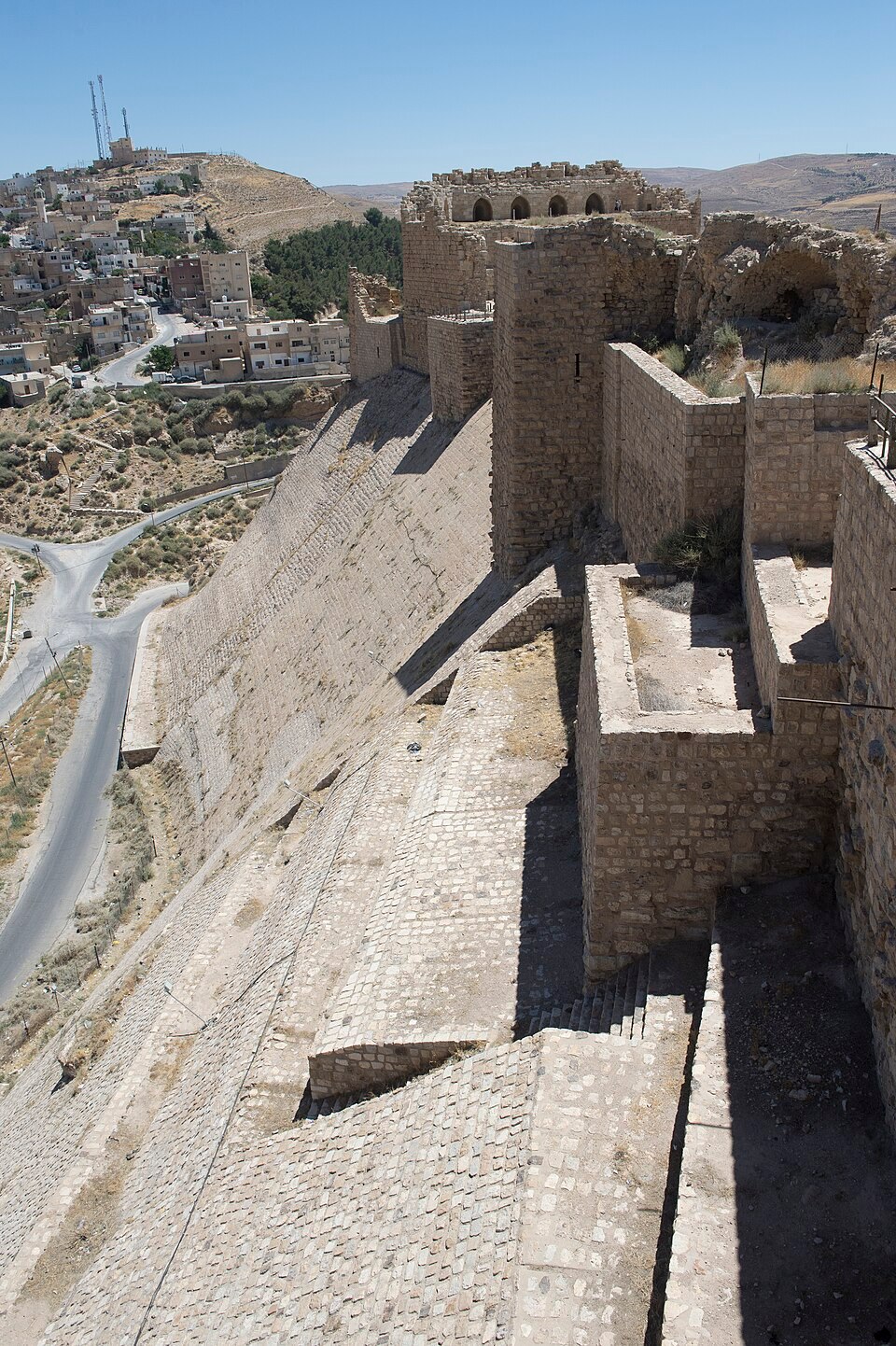
Kerak stands on the plateau east of the Dead Sea in modern Jordan. The castle was a seat of the Frankish lordship of Oultrejordain and later of Muslim rulers who governed from the same heights. It enters Templar records first as the property of a future master, then as the seat of a Muslim ally.
From the king to Philip
The charter issued by Baldwin III of Jerusalem at Nazareth on 31 July 1161 names Kerak among the places granted to Philip of Milly in exchange for his western estates. Montréal appears beside it. The grant dealt with who would inherit, which tenants would perform service and which rights the king kept. It preceded Philip’s entry into the Temple.
Two sieges
William of Tyre described the siege of Kerak in 1183, when a wedding had brought the royal family and its allies together there. A relief army approached and Saladin withdrew. The following summer he returned. In his report to the envoys in the West, Baldwin IV of Jerusalem said the second siege lasted four weeks. He also recorded what happened beyond the castle. Saladin withdrew by way of Nablus, whose residents took refuge while their district was devastated.
An Ayyubid court
By 1244 the ruler at Kerak was one of the Muslim allies named by Armand de Périgord. Armand’s letter to Robert de Sanford defended an agreement with the rulers of Kerak and Damascus against Egypt. The regional interests that had once made Kerak a prize in a war with Saladin now brought its Ayyubid ruler and the Templar master into the same alliance.
References
- Baldwin III’s exchange of estates with Philip of Nablus, 31 July 1161. The Crusades Regesta, RRR 670. The act issued at Nazareth lists the castles, exceptions, family consents, witnesses and the chancellor who drew up the charter.
- William of Tyre, History, book XXII. Chapters 1, 25–27 and 29–30 on Sibylla’s second marriage, Guy’s regency, the coronation of Baldwin V and relief of Kerak.
- Baldwin IV to the envoys in the West, 1184. The Crusades Regesta, RRR 1148. The king reports damage to his kingdom. The editors identify what the envoys carried.
- Armand de Périgord’s letter on the Syrian alliance, 1244. The Crusades Regesta, RRR 2459. The master explains his negotiations with Muslim rulers to the Templar preceptor in England.
- Armand de Périgord to Robert de Sanford. Latin text in Matthew Paris, Chronica majora, ed. H. R. Luard, vol. IV, pp. 288–291. The printed p. 289 opens with the English preceptor’s name and office.

Illustration. Dosseman. Original image and catalogue record. CC BY-SA 4.0. Resized for display.
