 Knights Templar
Philip of Milly
Philip of Milly had been a landholder, a royal witness and lord of a frontier territory before he became master of the Knights Templar in 1169. He is also called Philip of Nablus, after the town he held in the Kingdom of Jerusalem. His career can be followed through changes in the way other people addressed him, and once through an account he gave in his own name.
Lord of Nablus
As lord of Nablus, Philip appears among the witnesses to royal business long before he entered the Temple. On 27 June 1155 he witnessed an exchange of estates confirmed by Baldwin III of Jerusalem. André de Montbard appears in the same list as master of the Temple. In the royal charter of 1161, Philip exchanged his northern lordship for Oultrejordain, the territory east of the Dead Sea. It brought him into closer contact with travelers and religious houses on the road south.
A gift he could vouch for
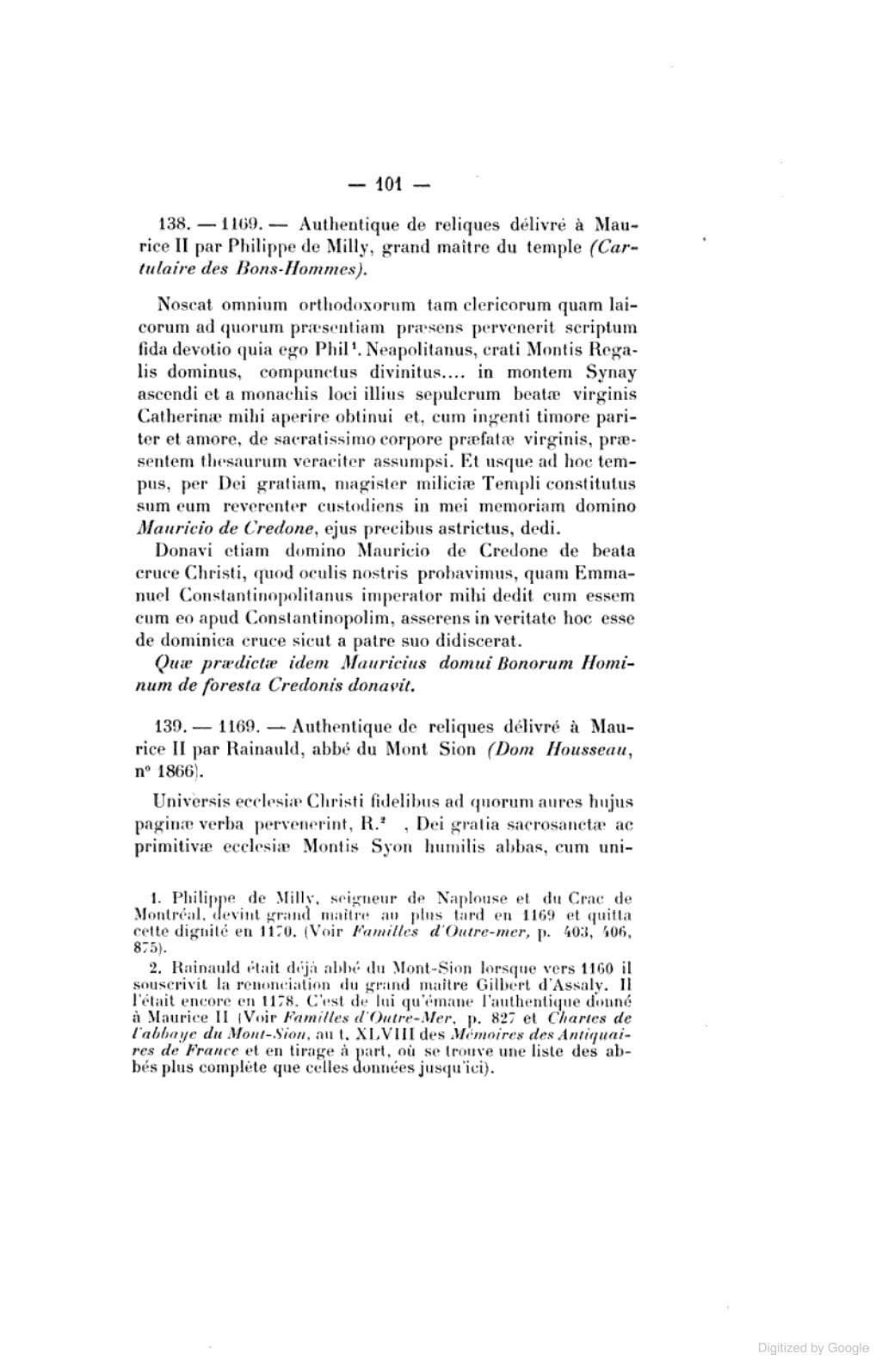
In a document dated to about March 1169, Philip described two relics he was giving away. While he governed the territory east of the Dead Sea, he said, monks at Mount Sinai had given him a fragment they identified as a relic of Saint Catherine. At Constantinople the emperor had personally given him wood revered as part of the Cross. Philip’s is the first of the nine relic letters printed together in the Craon family cartulary. It records how both objects came into his hands. The document identifies the donor as master of the Temple.
Resignation and royal service
Royal acts also name Philip as master later in 1169. His tenure was short. When Amalric of Jerusalem traveled to Constantinople in 1171, Philip went ahead on the king’s business. William of Tyre expressly says that he had already laid down the mastership. He thus returned to royal service with experience few envoys could match, as a former territorial lord, head of a religious order and visitor to the imperial court. The sources give no comparable account of his last days.
References
- A. Bertrand de Broussillon, La Maison de Craon, I, nos. 138–145. Printed Latin texts, pp. 101–105. No. 138 contains Philip’s account, no. 144 Stephana’s certificate and no. 145 Amalric’s letter.
- Philip of Milly’s gift of relics, 1169. The Crusades Regesta, RRR 825. English abstract. Latin edition in La Maison de Craon, I, no. 138.
- Baldwin III’s exchange of estates with Philip of Nablus, 31 July 1161. The Crusades Regesta, RRR 670. The act issued at Nazareth lists the castles, exceptions, family consents, witnesses and the chancellor who drew up the charter.
- Baldwin III’s confirmation of an exchange of estates. Jerusalem, 27 June 1155. The Crusades Regesta, RRR 574, citing Mayer, Urkunden, no. 236.
- William of Tyre, History, book XX. Chapter 24 identifies Philip as a former master and describes the king’s embassy. Chapters 31–32 recount the killing of an envoy and the dispute with Odo.
- Les familles d’outre-mer, masters of the Temple. Du Cange, revised by E.-G. Rey (1869), pp. 875–883. The editor compares witness lists and corrects earlier attempts at the succession.
Illustration. A. Bertrand de Broussillon, La Maison de Craon, vol. I (1893). Original image and catalogue record. Public domain. Resized for display.