 Knights Templar
Catherine of Alexandria
Catherine of Alexandria is the Christian martyr whose shrine at the foot of Mount Sinai drew pilgrims from across the Mediterranean. In the twelfth century one visitor was Philip of Milly, later master of the Templars. His letter records what the monks gave him. The story of Catherine’s own lifetime comes down through religious tradition.
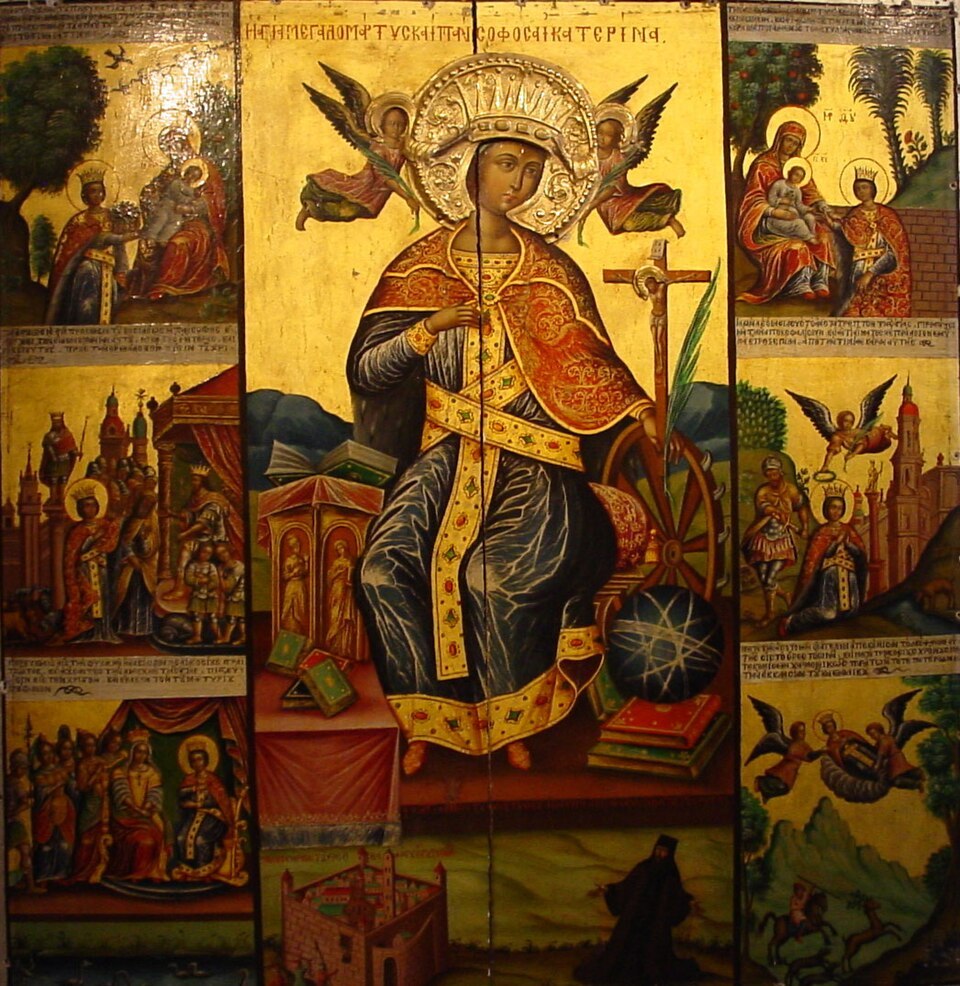
The martyr and the wheel
In the account preserved by the Sinai community, Catherine was an educated Alexandrian who defended Christianity before the emperor. The scholars summoned to refute her became converts themselves. Western artists commonly gave her a wheel. In the version illustrated by Raphael around 1507, the wheel intended for her execution broke before it could harm her, and she was beheaded. The wheel lets a viewer recognize Catherine even when a painting shows her alone.
From Alexandria to Sinai
According to the monastery’s tradition, angels carried Catherine’s body to the peak that bears her name. Her shrine was established in the church of Saint Catherine’s Monastery. Veneration spread westward. The community traces an important stage to the arrival of relics in Rouen in the early eleventh century. In time the saint’s association with the house became so familiar that pilgrims called the monastery itself Saint Catherine’s.
Philip’s testimony
Philip recalled receiving a fragment identified as Catherine’s from the monks while he was lord of Montréal. By about March 1169 he was able to pass it on to Maurice of Craon. His account places a named pilgrim at the shrine and explains how a relic reached a named recipient. It offers no independent testimony about the circumstances of the martyr’s death.
References
- A. Bertrand de Broussillon, La Maison de Craon, I, nos. 138–145. Printed Latin texts, pp. 101–105. No. 138 contains Philip’s account, no. 144 Stephana’s certificate and no. 145 Amalric’s letter.
- Holy Monastery of Sinai, Saint Catherine. The community’s account of the saint’s legend, the transfer of relics to Rouen and the shrine in the monastery church.
- National Gallery, Raphael’s Saint Catherine of Alexandria. Catalogue entry NG168. The gallery explains the wheel in the painting and the story that made it the saint’s attribute.
- Philip of Milly’s gift of relics, 1169. The Crusades Regesta, RRR 825. English abstract. Latin edition in La Maison de Craon, I, no. 138.
Illustration. Orthodox33. Original image and catalogue record. Public domain. Resized for display.
