 Knights Templar
Battle of La Forbie
At La Forbie, near Gaza, in October 1244, the army of al-Salih Ayyub and his Khwarazmian allies defeated a coalition from the Frankish kingdom and the Muslim states of Syria. The name La Forbie preserves the Frankish rendering of Harbiya. Many members of the military orders died or went into captivity, among them the Templar master Armand de Périgord, whose ultimate fate is uncertain.
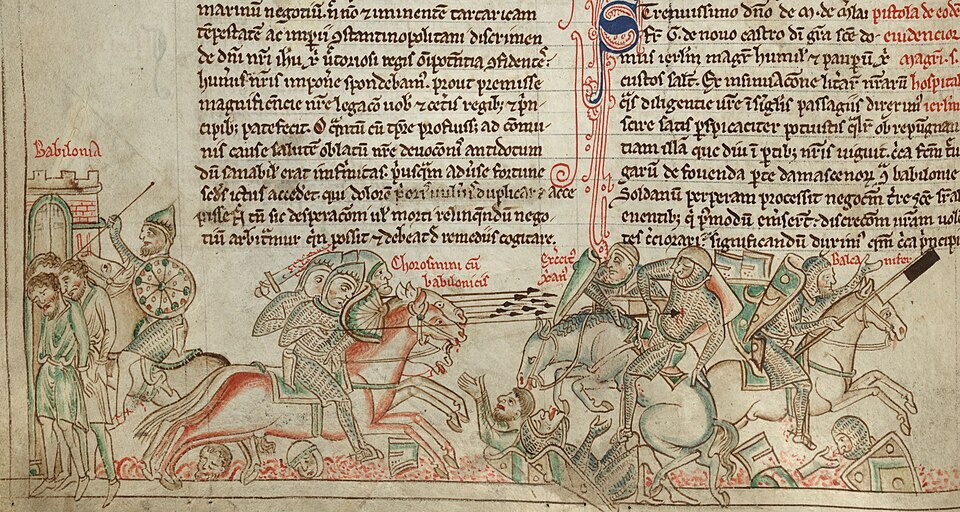
How the armies came together
In the spring Armand had written to Robert de Sanford in England explaining his break with Egypt. Envoys sent to obtain the return of towns including Gaza and Nablus had been detained for months. The rulers of Damascus and Kerak offered other terms, and their men were helping the Templars guard the southern approach to the kingdom. That summer Khwarazmian forces entered Jerusalem, killed many of its remaining Christian inhabitants and moved south toward Gaza. There they joined forces acting for the Egyptian sultan.
A defeat for two armies
The Syrian contingents broke under the Khwarazmian attack. The Franks and the military orders then faced their enemies with little prospect of relief. Chroniclers give incompatible totals for the dead. The damage is easier to trace in what followed. The Temple had to find new leadership, and the rulers of Damascus and Kerak lost the strength to maintain their former positions. In Cairo, Egyptian officials paraded captured Syrian commanders as well as captured Franks. Within a year the Egyptian sultan had gained Damascus.
References
- Armand de Périgord to Robert de Sanford. Latin text in Matthew Paris, Chronica majora, ed. H. R. Luard, vol. IV, pp. 288–291. The printed p. 289 opens with the English preceptor’s name and office.
- Armand de Périgord’s letter on the Syrian alliance, 1244. The Crusades Regesta, RRR 2459. The master explains his negotiations with Muslim rulers to the Templar preceptor in England.
- Al-Maqrizi, al-Suluk, account of the crusade of Louis IX. The Egyptian historian compiled his account more than a century after the events. English translation in Chronicles of the Crusades (1848), reproduced by Fordham University. The editorial footnotes are distinct from the chronicle.
- Les familles d’outre-mer, masters of the Temple. Rey’s revised edition, pp. 882–889, including variant names, dated documents and the contested succession after La Forbie.

Illustration. Matthew Paris, Corpus Christi College, Cambridge, MS 16 II. Original image and catalogue record. Public domain. Resized for display.
