 Knights Templar
Jacques de Molay
Jacques de Molay was the last master of the Knights Templar. He entered the Temple as a young man in Burgundy and was elected around 1292, after the order had lost Acre. He spent much of his mastership trying to recover a foothold on the coast. He outlived the order itself by nearly two years and was executed in Paris in 1314.
An order based on Cyprus
Molay succeeded Thibaud Gaudin on Cyprus. The island gave the Templars harbors, estates and a base within sailing distance of Syria. Around 1300 they joined renewed attempts to establish a presence near Tortosa. The offshore island of Ruad offered an anchorage and a small garrison, but could not sustain the hoped-for return. The Mamluk capture of Ruad in 1302 cost the Temple men who were killed or taken prisoner.
Summoned to the West
When Pope Clement V sought advice on a new expedition and a possible union of the Temple with the Knights Hospitaller, Molay came west. He opposed the merger. Separate orders had their own vows, estates and obligations to donors, as well as different traditions of service. Meanwhile allegations about the Templars’ admission ceremony were reaching the French court. On 13 October 1307 officers acting for Philip IV of France arrested brothers throughout France, including the master.
Interrogation and suppression
Molay admitted some accusations under interrogation and subsequently challenged the use made of his confession. The Trial of the Templars produced several distinct proceedings. Individuals were questioned about their own reception, while a papal commission considered allegations against the order as a whole. At the council held in Vienne in 1312 Clement suppressed the institution by papal decision. The decree explained why the pope believed the order could no longer continue and expressly distinguished his decision from a judicial finding against it.
Execution in Paris
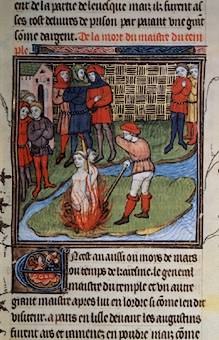
In March 1314 Molay was brought before churchmen in Paris to hear a sentence of perpetual imprisonment. He repudiated his confession and defended the order. The king’s government had him burned that evening. The account of this reversal and execution comes from narrative sources. The much larger surviving body of legal records tells us what questions were asked and what answers the investigators chose to enter, often after coercion.
References
- Le Procès des Templiers. Trial records edited by Jules Michelet, vol. I. The proceedings distinguish testimony about individual brothers from the commission’s inquiry into the order.
- Council of Vienne. Vox in excelso and Ad providam, 1312. Clement V sets out the grounds for suppression and the disposition of the order’s property.
- The Templar of Tyre, Chronicle. Part III of Les Gestes des Chiprois, edited by Gaston Raynaud (1887). See §306 on the earlier captivity of Beaujeu and Gaudin and the entries for 1289–1291 on Tripoli, Acre and the remaining coastal towns.
- Les familles d’outre-mer, masters of the Temple. Rey’s revised edition, pp. 889–892, collating royal acts, chronicles and records of the trial.
- Charles Moeller, The Knights Templars. A historical survey of the Templar habit, the red cross and the classes of brethren.
Illustration. Anonymous illuminator, British Library. Original image and catalogue record. Public domain. Resized for display.
