 Knights Templar
Tortosa
Tortosa, modern Tartus, stands on the Syrian coast opposite the island of Ruad. Its medieval cathedral and its Templar castle were distinct institutions. The bishop governed a diocese and held rights in the town. The Knights Templar acquired a site for their castle and the right to maintain a chapel inside it.
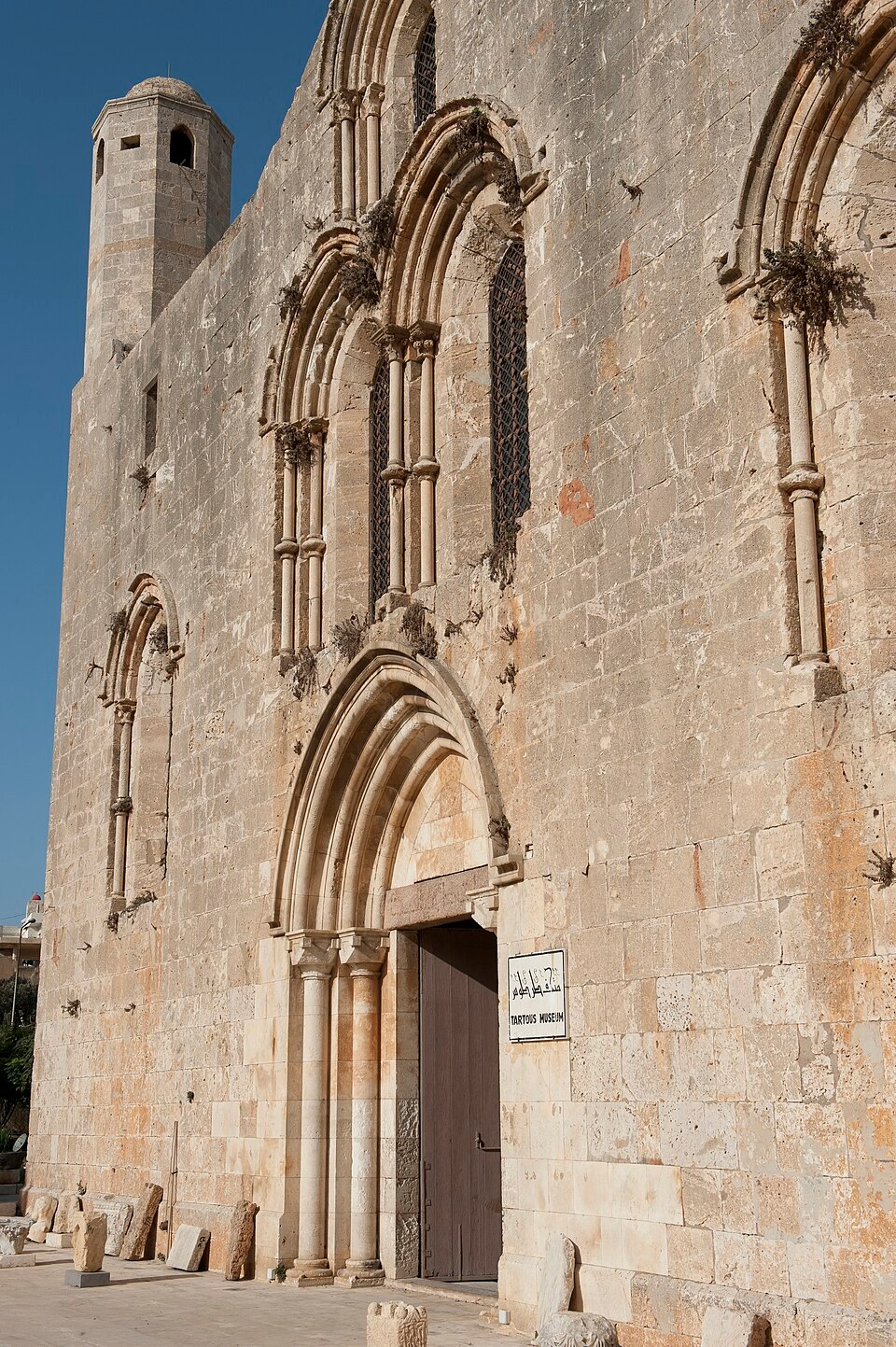
Rebuilding a burned town
In 1152 William, bishop of Tortosa, asked the master Everard des Barres to help rebuild a town that, in the language of their agreement, had been taken, burned and left deserted. The bishop and chapter offered part of a former residential quarter for the castle. Their agreement traced the plot past a named house to the gate of Saint Helena. The bishop wanted enough security to restore the cathedral of Saint Mary and its community.
A chapel and a port
The bishop retained jurisdiction over the churches in town and at the port, except for the new Templar chapel. When the Earthquake of 1202 wrecked other coastal towns, Philippe du Plessis reported that both town and castle at Tortosa had escaped. In the next century its castellan Renaud de Claincourt took part in negotiations over inland property. His presence alongside the castellan of Chastel Blanc shows two houses conducting business together across the diocese.
The evacuation of 1291
After the fall of Acre, the remaining Frankish ports could no longer count on help from a mainland capital. The Temple abandoned Tortosa in 1291. Men based on Cyprus later returned to the island offshore, which remained close enough for them to cross to the mainland. The Fall of Ruad in 1302 ended that foothold.
References
- Agreement between the bishop of Tortosa and the Temple. Tripoli, 1152. The Crusades Regesta, RRR 532, identifying the edition by Jonathan Riley-Smith.
- Philippe du Plessis to the abbot of Cîteaux, 1202. The Crusades Regesta, RRR 1509. The master reports conditions on the frontier, earthquake damage, disease and crop losses.
- Boundary settlement between the Temple and the Hospital, May 1243. Old French text, Joseph Delaville Le Roulx, Cartulaire général de l’ordre des Hospitaliers, vol. II, no. 2296, pp. 602–603. The names of the arbitrators, the landmarks and Richard’s sealing clause appear on printed p. 603.
- The Templar of Tyre, Chronicle. Part III of Les Gestes des Chiprois, edited by Gaston Raynaud (1887). See §306 on the earlier captivity of Beaujeu and Gaudin and the entries for 1289–1291 on Tripoli, Acre and the remaining coastal towns.
- Les familles d’outre-mer, masters of the Temple. Rey’s revised edition, pp. 889–892, collating royal acts, chronicles and records of the trial.

Illustration. Dosseman. Original image and catalogue record. CC BY-SA 4.0. Resized for display.
