 Knights Templar
Chastel Blanc
Chastel Blanc, the White Castle, was the Templar stronghold at Safita in western Syria. Its surviving stone tower rises above the town and contains a chapel. From the medieval castle the brothers administered inland villages within reach of Tortosa on the coast and of the Hospitallers at Krak des Chevaliers farther east.
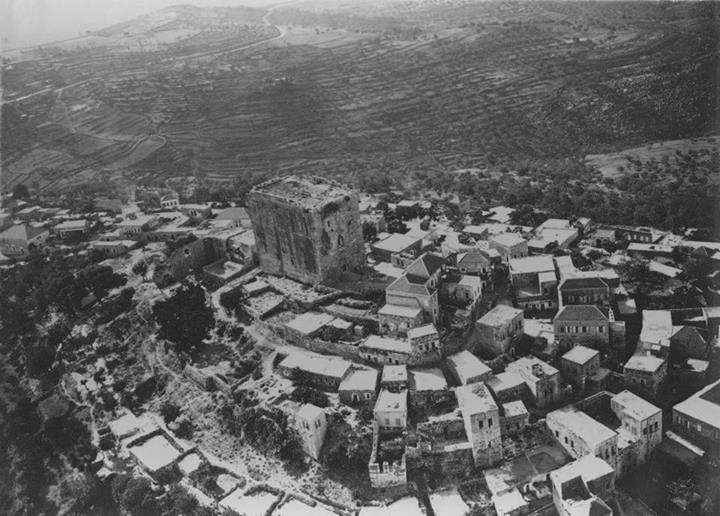
The castle’s income
An agreement made in 1152 between William, bishop of Tortosa, and the master Everard des Barres divided revenues within the diocese. Chastel Blanc appears as Castrum Album. The Templars were to retain all the returns from the villagers and knights covered by the clause there. The written grant makes it possible to see something of the castle’s household economy decades before anyone described damage to its tower.
The earthquake
In June 1202 Philippe du Plessis told the abbot of Cîteaux that most of the walls had suffered in the earthquake and that the great tower had also been damaged. His surprise is part of the report. The brothers had thought that tower without equal. His wording does not establish that every part of the tower standing today was already in place before the shock.
A castellan fixes a boundary
In the Tripoli boundary settlement of 1243, the castellan Richard de Bures helped settle where the lands of the two military orders met. The agreement followed a stream, hills and a cave, and ended with his promise to seal it in wax. The Temple lost Chastel Blanc to Baybars in 1271. Its administrative world can still be recovered in the names of the villages divided in the settlement.
References
- Agreement between the bishop of Tortosa and the Temple. Tripoli, 1152. The Crusades Regesta, RRR 532, identifying the edition by Jonathan Riley-Smith.
- Philippe du Plessis to the abbot of Cîteaux, 1202. The Crusades Regesta, RRR 1509. The master reports conditions on the frontier, earthquake damage, disease and crop losses.
- Boundary settlement between the Temple and the Hospital, May 1243. Old French text, Joseph Delaville Le Roulx, Cartulaire général de l’ordre des Hospitaliers, vol. II, no. 2296, pp. 602–603. The names of the arbitrators, the landmarks and Richard’s sealing clause appear on printed p. 603.
- Settlement between the Temple and Hospital, 1243. The Crusades Regesta, RRR 2422. The act of 31 May names Richard and his office and records the decision of the arbitrators.
- The Templar of Tyre, Chronicle. Part III of Les Gestes des Chiprois, edited by Gaston Raynaud (1887). See §306 on the earlier captivity of Beaujeu and Gaudin and the entries for 1289–1291 on Tripoli, Acre and the remaining coastal towns.

Illustration. Pierre Antoine Berrurier. Original image and catalogue record. Public domain. Resized for display.
