 Knights Templar
Fall of Acre (1291)
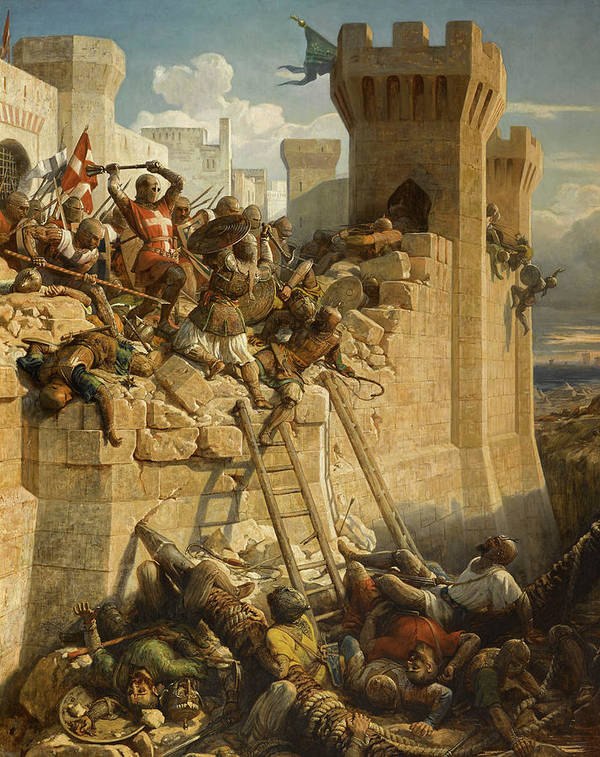
On 18 May 1291 the army of the Mamluk sultan al-Ashraf Khalil broke into Acre. Ships carried some inhabitants to Cyprus. Others were killed or taken captive in the streets and at the waterfront. The Templar compound held out for about ten more days. Its loss ended the order’s long residence in the city recovered during the Third Crusade.
The truce before the siege
The Templar of Tyre describes Muslim farmers bringing grain and other goods to the market at Acre under a truce. Newly arrived crusaders attacked and killed them. Among the victims were local eastern Christians whom their attackers took for Muslims. The sultan Qalawun demanded justice. The city’s leaders could not agree on a response. Qalawun began preparations to march but died in 1290. His son Khalil brought the Egyptian and Syrian armies together the following spring.
From the other side of the walls
Abu al-Fida, a young officer from Hama, remembered the winter journey from Krak des Chevaliers. Rain, snow and the loss of draft animals stretched a journey normally made in eight days on horseback to a month. The Templar household chronicler remembered a different moment, the attempt by envoys to obtain terms for the people inside. The sultan offered them departure if they would surrender the city. The negotiations broke down.
The city and the harbor
William of Beaujeu was mortally wounded on 18 May. Mathieu de Clermont, the Hospitaller marshal, died fighting near the Genoese quarter. Civilians crowded toward the ships. The Templar chronicler describes families separated in flight and two Genoese galleys picking people out of the water. Henry II of Cyprus escaped. The Temple’s walled enclosure sheltered wounded brothers and townspeople until its final collapse. The Templar marshal Peter of Sevry died after leaving it to negotiate.
After Acre
Survivors reached Sidon, where the brothers with Thibaud Gaudin elected him master. Refugees who found passage across the sea faced dearer food and scarce housing on Cyprus. Abu al-Fida remembered the conquest as a reversal of the loss of Acre to the crusaders a century earlier. In both accounts the change of rule extended beyond the city as other coastal settlements were abandoned.
References
- Templar of Tyre, account of Acre and the refugees. Les Gestes des Chiprois, ed. Gaston Raynaud, §§479–516. See §§498–508 on the city and §§509–516 on Sidon and Cyprus.
- Abu al-Fida, Annals, the conquest of Acre. Historiens orientaux, I, pp. 163–165. Abu al-Fida describes his own part in the expedition and the occupation of the ports. Use the Frankish chronicle for the date 18 May.
- Ludolf of Sudheim, account of the loss of Acre. Later testimony assembled from people who recalled the city. English translation by Aubrey Stewart, excerpted by Fordham University.
Illustration. Dominique Papety, about 1840. Original image and catalogue record. Public domain. Resized for display.
