 Knights Templar
William of Beaujeu
William of Beaujeu led the Temple from 1273 until his death at Acre in 1291. An unnamed writer who had worked in his household left a long account of the last years of the Frankish coast. Known as the Templar of Tyre, he had access to men and news close to the master. His affection for William is evident throughout his chronicle.
A career before the mastership
William had already known captivity in the eastern wars. The chronicler names both him and Thibaud Gaudin among the brothers taken in an earlier engagement. After his election William attended the Second Council of Lyon in 1274, where plans for assistance to the eastern Christians were debated. Much of his career thereafter was spent trying to preserve alliances among the competing authorities in the ports he defended.
The fall of Tripoli
After the fall of Tripoli in 1289, Acre became still more exposed. William’s household received information about the Mamluk court and the prospects of a renewed attack. The Templar of Tyre says that William sent a second messenger when people dismissed the first warning. Merchants and householders had livelihoods bound up in the city. A master could call his brothers to their posts more easily than he could persuade a town to abandon its property.
Death at Acre
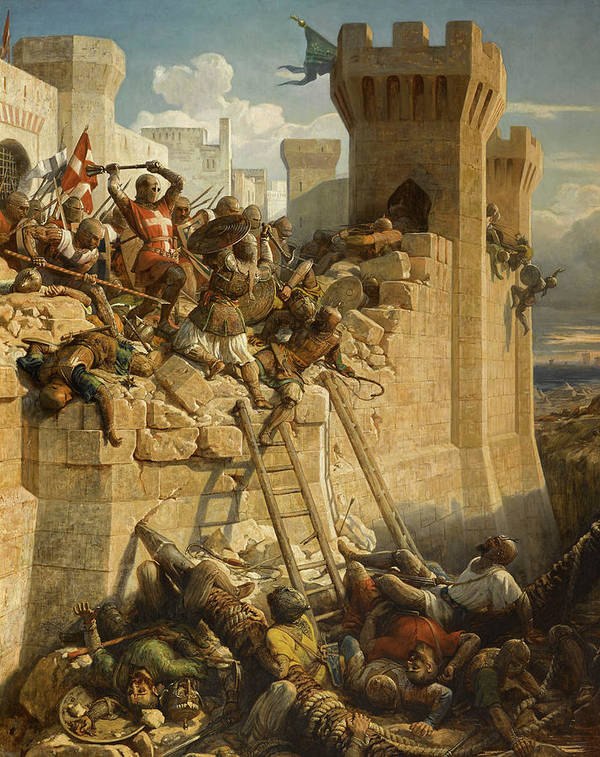
During the siege of 1291 the Templars defended the city alongside the Hospitallers, royal troops and townspeople. On 18 May William was wounded as the defenses gave way. The household chronicler says that men who saw him leaving his position thought he was withdrawing of his own accord. Only when he showed them the wound did they understand. He died that day. The Templar compound beside the harbor continued to shelter people trying to leave by sea.
References
- The Templar of Tyre, Chronicle. Part III of Les Gestes des Chiprois, edited by Gaston Raynaud (1887). See §306 on the earlier captivity of Beaujeu and Gaudin and the entries for 1289–1291 on Tripoli, Acre and the remaining coastal towns.
- The Fall of Acre, 1291. Medieval account of the siege, the evacuation by sea and the last days of the Temple compound.
- Les familles d’outre-mer, masters of the Temple. Rey’s revised edition, pp. 889–892, collating royal acts, chronicles and records of the trial.
Illustration. Dominique Papety, about 1840. Original image and catalogue record. Public domain. Resized for display.
