 Knights Templar
Zengi
Imad al-Din Zengi (died 1146), ruler of Mosul and Aleppo, captured Edessa in 1144. The attack took place during a struggle among neighbouring Muslim and Frankish rulers in northern Syria and Mesopotamia. His greatest victory outlived him as a rallying point for the Second Crusade.
Rule from two cities
Zengi acquired Mosul in 1127 and Aleppo the following year. Holding both connected lands east of the Euphrates to the frontier near Antioch. Damascus retained its own rulers, who at times worked with Jerusalem to resist him. His power and the alliances made against him cut across the religious divisions described in the rhetoric of holy war.
Edessa and his death
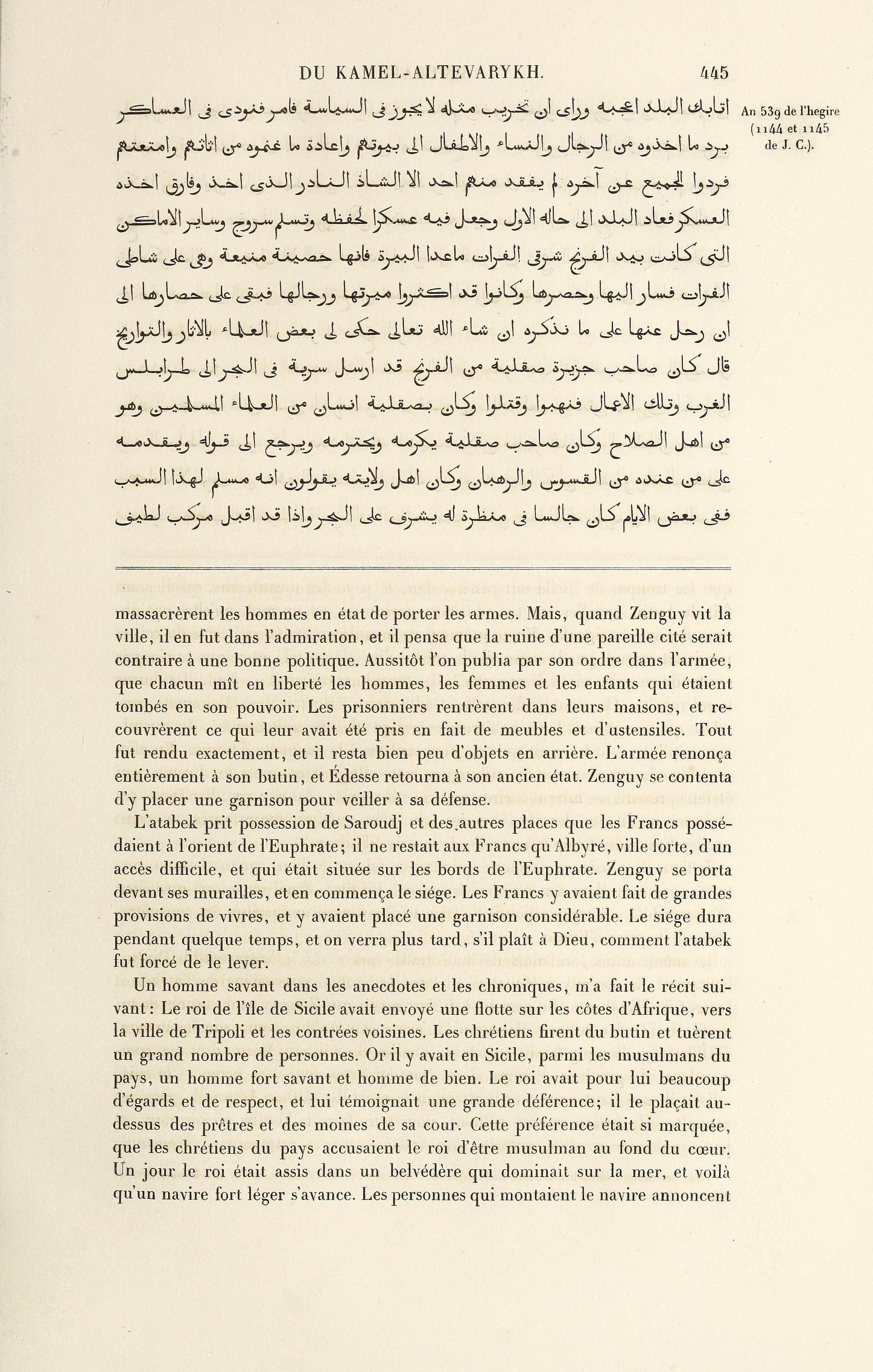
In December 1144 his army entered Edessa after a siege. William of Tyre remembers the deaths and the panic that followed the breach. Ibn al-Qalanisi records the rejoicing that greeted the news among Muslims. Ibn al-Athir later credited Zengi with ordering that the surviving inhabitants and their property be returned, since an empty city would be of little use to him. Zengi died in 1146 while besieging a fortress on the Euphrates. His lands then passed to different members of his family. It was his son Nur al-Din, established in Aleppo, who had to meet the first attempt to recover Edessa.
References
- William of Tyre, History, book XVI. Chapters 4–7 on the capture and sack of Edessa and the division of Zengi’s lands. Chapters 14–16 on the attempt to recover the city. Latin text.
- Ibn al-Qalanisi, The Damascus Chronicle of the Crusades. English selection translated from Arabic by H. A. R. Gibb. See the entries for 539 AH on Edessa, 541 AH on Zengi’s death and 549 AH on the transfer of Damascus.
- Ibn al-Athir, The Complete History, events of 539 AH. Recueil des historiens des croisades, Historiens orientaux, I, pp. 443–446. Arabic text above the French translation. See p. 445 on the ruler’s instructions concerning the inhabitants.
Illustration. Recueil des historiens des croisades, Historiens orientaux, vol. I, p. 445. Original image and catalogue record. Public domain. Resized for display.
