 Knights Templar
Pelagius of Albano
Pelagius, cardinal-bishop of Albano, served as papal legate in the eastern Mediterranean during the Fifth Crusade. In Egypt he was one of several leaders whose authority had to operate alongside that of a king, the military orders and contingents from different countries.
Waiting at Damietta
Peter de Montaigu wrote in 1220 that the legate and clergy wished to advance while secular commanders feared that moving inland would leave too small a garrison at Damietta. In January 1221 Pope Honorius III gave Pelagius discretion to negotiate a temporary truce. When the army finally went forward, Peter’s later account described the decision as one reached in council. That testimony qualifies the later habit of treating the legate alone as responsible for the disaster.
Judge at Acre
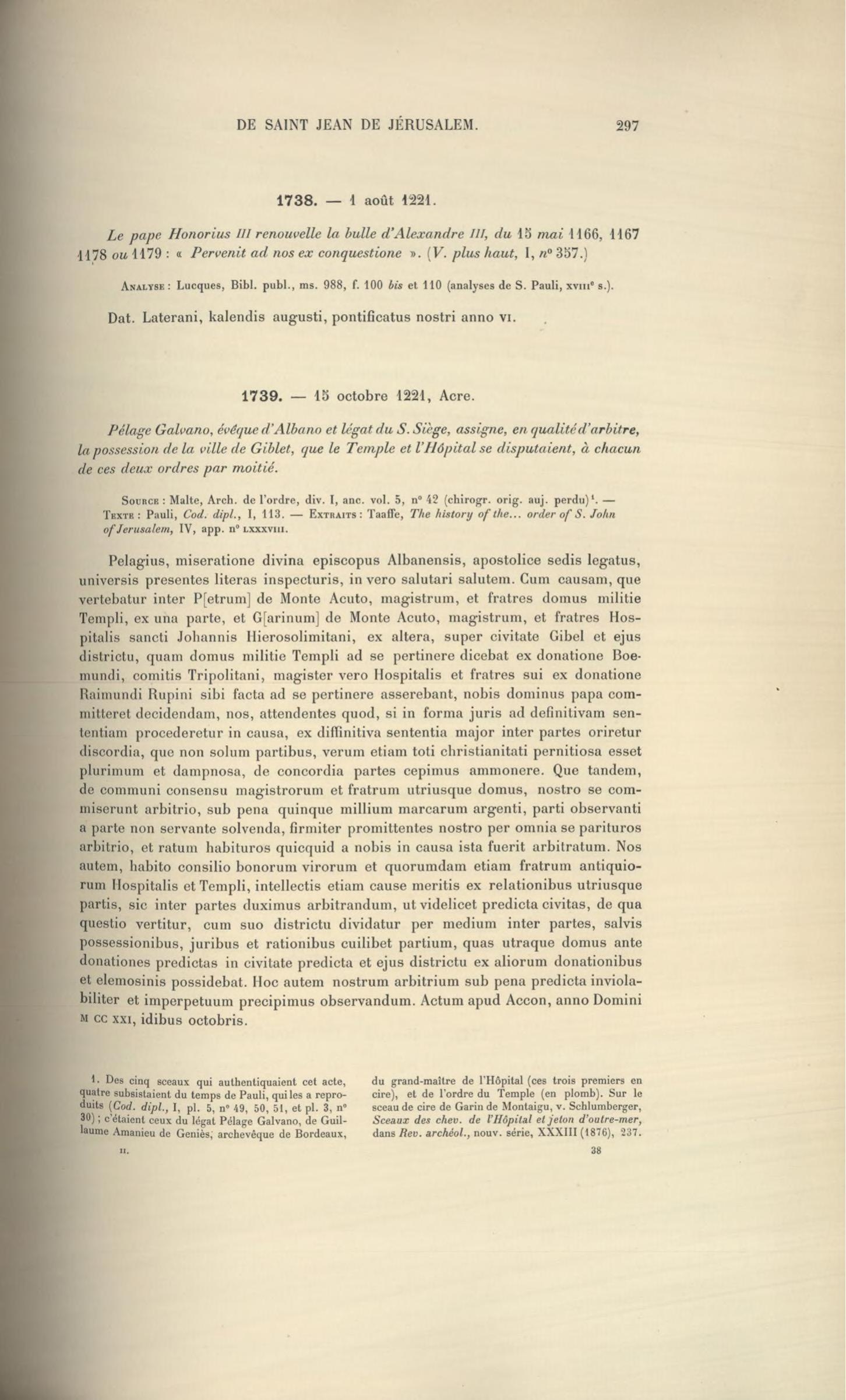
After Damietta was surrendered Pelagius sat at Acre as arbitrator between Temple and Hospital. His award named the masters, the rival princely grants and the penalty to which both sides agreed. The powers he exercised in this hearing arose from a specific submission by the two orders.
References
- Peter de Montaigu to the bishop of Ely, 1220. The Crusades Regesta, RRR 1858. The master reports opposing views about leaving Damietta to advance into Egypt.
- Honorius III to Pelagius of Albano, January 1221. The Crusades Regesta, RRR 1869. Permission to negotiate a short truce pending the emperor’s arrival.
- Peter de Montaigu’s account of the withdrawal from Egypt, 1221. The Crusades Regesta, RRR 1886. Letter from Acre to the order in England after the surrender of Damietta.
- Pelagius of Albano, award concerning Gibel, 15 October 1221. Latin text. Delaville Le Roulx, Cartulaire général de l’ordre des Hospitaliers, vol. II, p. 297, no. 1739. The ruling sets out the competing grants and the penalty for refusing the arbitration.

Illustration. Joseph Delaville Le Roulx, ed., Cartulaire général de l’ordre des Hospitaliers, vol. II. Original image and catalogue record. Public domain. Resized for display.