 Knights Templar
Fourth Crusade
The Fourth Crusade was the expedition called by Pope Innocent III that conquered Constantinople in April 1204. Its leaders had contracted with Venice to carry an army against Egypt. The capture of two Christian cities, Zara and the Byzantine capital, changed where the army went, whom it fought and what became of the lands it occupied.
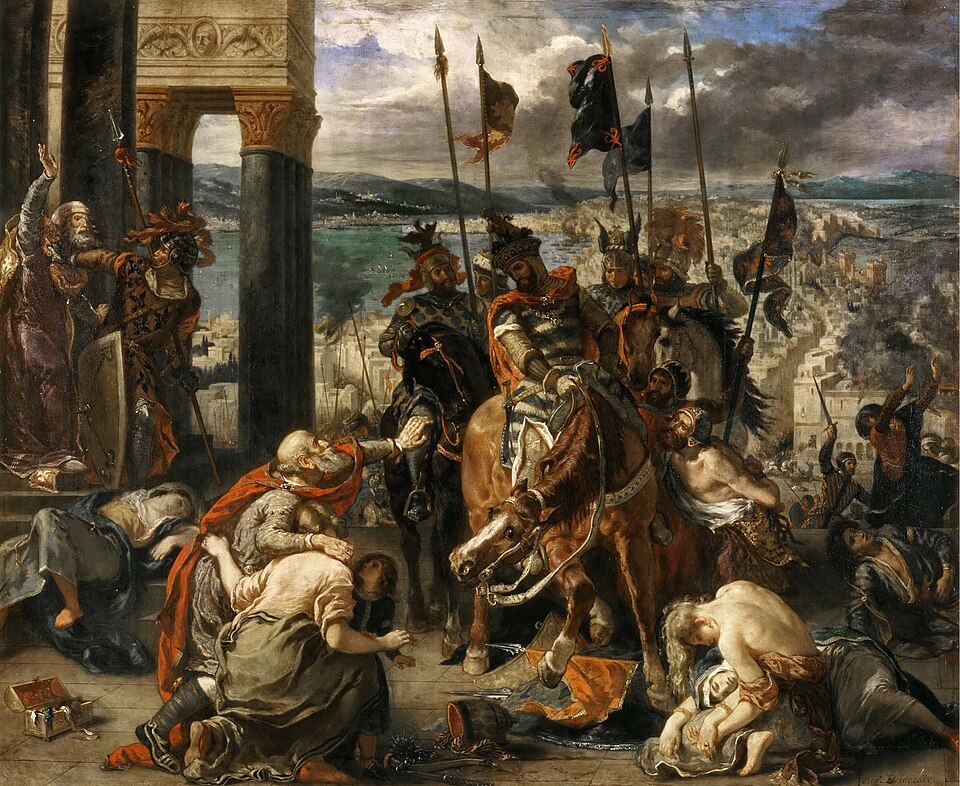
A fleet larger than the army
Geoffrey of Villehardouin helped negotiate the Venetian shipping contract. The city undertook to transport and provision a large army for an agreed price. Fewer crusaders assembled at Venice than the negotiators had counted on. Some had chosen other ports. Those who did arrive owed money for a fleet built to carry many more. Doge Enrico Dandolo offered to defer part of the debt if they helped Venice recover Zara. The army took the Adriatic city in November 1202. Some crusaders refused to participate.
A Byzantine claimant
During the winter the army considered an offer from Alexios IV Angelos. If the crusaders helped restore his father to the Byzantine throne, he promised money, military assistance and support for union with the Roman church. The fleet reached Constantinople in 1203. The young man gained a crown, but the payments on which the crusaders depended made his position in the city more precarious. After he was overthrown and killed, the leaders agreed among themselves how to divide the empire they now proposed to conquer.
The sack and its witnesses
The assault and sack left the crusaders in possession of the capital. Villehardouin described the collection and division of spoils. Niketas Choniates, a Byzantine official who escaped the city, described the violation of churches and the humiliation of inhabitants in their homes. The new Latin empire absorbed men who had vowed to go to the Holy Land. Innocent’s subsequent reprimand to Peter of Capua asked how such an expedition could persuade Greek Christians to trust the Latin church.
References
- Geoffrey of Villehardouin, The Conquest of Constantinople. In Frank Marzials’s translation, Memoirs of the Crusades. The narrative of a participant in the Fourth Crusade.
- Contemporary accounts of the Fourth Crusade. Translations from the account of Robert of Clari, the sailing agreement and other testimony concerning Venice, Zara, Constantinople and the division of spoils.
- Niketas Choniates, account of the sack of Constantinople. English extract from the Byzantine official’s history. The account describes the violation of churches and the seizure of goods in April 1204.
- Innocent III, reprimand to his legate after the Fourth Crusade. The pope’s letter to Peter of Capua on the release of crusaders from their vows and the treatment of the Greeks. English translation by James A. Brundage.
Illustration. Eugène Delacroix. Original image and catalogue record. Public domain. Resized for display.
