 Knights Templar
Palermo
Palermo is the great harbour on the north coast of Sicily and the seat from which the Norman kings governed the island and much of southern Italy. The palace, chapel and cathedral preserve different aspects of a capital whose rulers drew on Latin, Greek and Arabic traditions.
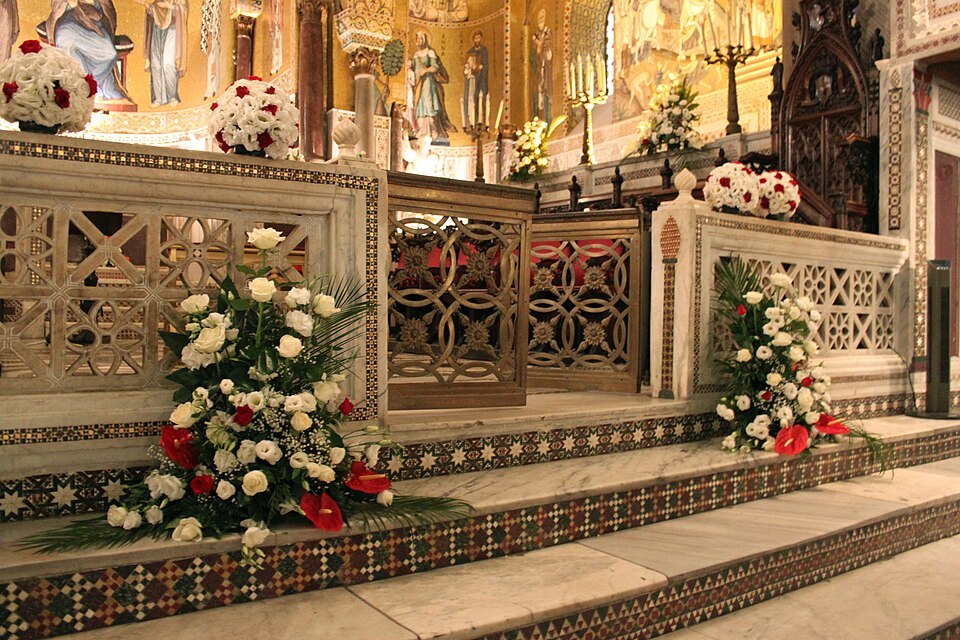
The palace chapel
In the Cappella Palatina the walls carry mosaics in a Byzantine tradition, while the nave has a painted and carved wooden ceiling with deep projecting cells. Seen together they preserve work by craftsmen familiar with quite different forms of court and religious decoration. The building served a Latin Christian monarchy that governed Greek-speaking Christians and Muslims as well as Latin Christians.
Frederick’s city
Frederick II inherited the Sicilian crown as a child and was crowned in Palermo in 1198. The court he assembled as an adult also travelled and governed from the Italian mainland. His expedition to the Kingdom of Jerusalem set out from Apulia. After his death in 1250, his body was brought back to Palermo for burial in the cathedral. The surviving imperial tomb belongs to the history of that Sicilian kingship as much as to his role in the crusades.
References
- Italian National Tourist Board, Palermo and its Arab-Norman monuments. Institutional descriptions of the royal palace, churches, mosaics and surviving fabric of the Norman capital.
- First Council of Lyon, decisions of 1245. The sentence concerning Frederick II and the decrees for aid to the Holy Land in the English translation of the conciliar acts.
- Frederick II and al-Kamil, truce of 1229. The Crusades Regesta, RRR 2098. The register identifies both Arabic and Frankish narratives of the agreement.
Illustration. Liilia Moroz. Original image and catalogue record. CC BY-SA 4.0. Resized for display.
