 Knights Templar
Berengaria of Navarre
Berengaria of Navarre married Richard I of England at Limassol on 12 May 1191 and was crowned queen there. The wedding took place during the English conquest of Cyprus, more than a thousand miles from the kingdom in which she became queen.
The voyage to Cyprus
Berengaria joined Richard’s expedition in Sicily and traveled with his sister Joan. When a storm scattered the fleet, their ship reached the coast of Cyprus. English narratives describe the women remaining offshore while the intentions of Isaac Komnenos of Cyprus were uncertain. Richard’s own arrival led to fighting, followed by the wedding and the formal coronation. The royal women then continued with the expedition to the eastern mainland.
Queen and widow
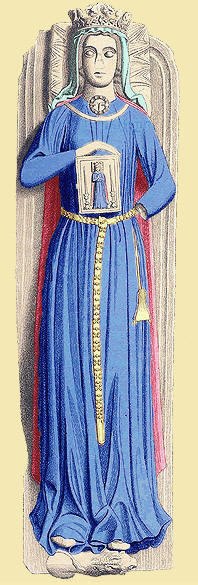
Berengaria survived Richard’s death in 1199 by more than thirty years. Her later life was centred on Le Mans, where she founded the Cistercian abbey of L’Épau and was buried in 1230. Her recumbent funeral effigy preserves the public image of a crowned widow. Much later antiquarian drawings of that tomb have often circulated as portraits of the young woman who went to Cyprus.
References
- Itinerarium peregrinorum, in Chronicles of the Crusades. Accessible English edition, 1882. The narrative of Richard’s expedition appears under the older attribution to Geoffrey of Vinsauf. See the sections on Cyprus and Acre.
- Neophytos, Concerning the Misfortunes of Cyprus. Greek text with English translation in C. D. Cobham, Excerpta Cypria, pp. 9–13. The preceding extract, pp. 6–9, gives the English expedition’s account.
- The Royal Household, Richard I Coeur de Lion. Outline of Richard’s reign, captivity, recovery of his French lands and death in 1199.
- Abbaye Royale de l’Épau, the royal abbey at Le Mans. The abbey preserves the recumbent effigy of its founder, Queen Berengaria of Navarre.
Illustration. Charles A. Stothard. Original image and catalogue record. Public domain. Resized for display.
