 Knights Templar
Crown of Thorns in Paris
The relic venerated in Paris as the Crown of Thorns came from the imperial treasury at Constantinople. Its transfer to Louis IX of France in 1239 brought together a Latin emperor short of money and a French king willing to spend heavily to acquire an object associated with Christ’s Passion. The medieval transfer is documented. The identification of the relic with the crown in the Gospels belongs to Christian tradition.
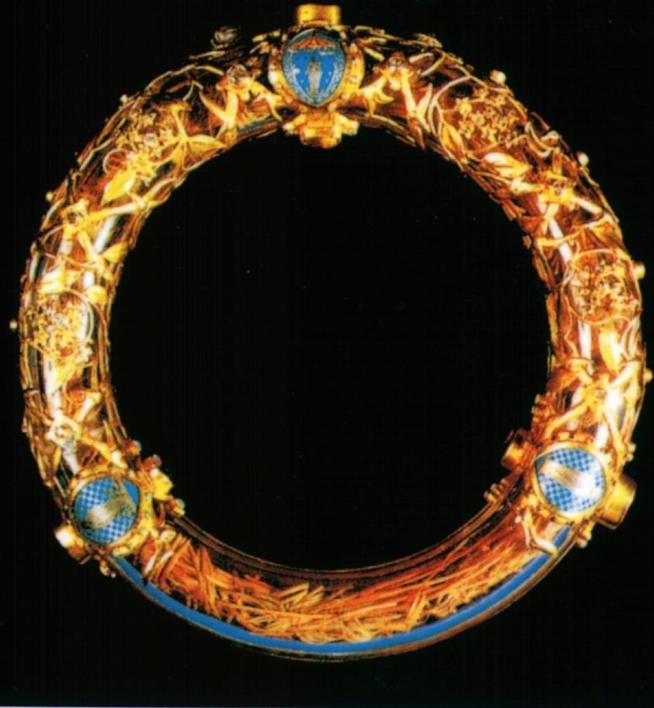
From Constantinople to the palace chapel
Baldwin II of Constantinople turned to western Europe for help maintaining his empire. Gauthier Cornut, archbishop of Sens, describes the pledge to a Venetian creditor and the checks on the seals that accompanied the transfer. After negotiations in Venice, Louis received the relic in France. Further Passion relics, including a fragment venerated as part of the True Cross, followed in 1241. Louis commissioned the Sainte-Chapelle to house the collection inside his palace. A stained-glass window there depicts the arrival of the relics in France.
Custody, display and worship
The Foundation charter of the Sainte-Chapelle endowed the religious community that cared for the collection. Physical custody required people and revenue, as well as a building. The object visible in photographs of the Paris relic is a circlet enclosed in a transparent reliquary. That case is a later work and should be distinguished from the medieval chest in which the king’s relics were kept.
References
- Gauthier Cornut, De susceptione coronae spineae. Latin account by the archbishop of Sens, printed in Recueil des historiens des Gaules et de la France, XXII, pp. 26–32. See pp. 30–31 for the pledge, seals, journey through Venice and French reception.
- Centre des monuments nationaux, History of the Sainte-Chapelle. The monument’s historical account of the acquisition of the relics and of the two levels of the palace chapel.
- Foundation charter of the Sainte-Chapelle. Photograph of the royal act and its pendant seal, with a description of the provision of income for the chapel.
- Centre des monuments nationaux, Saint Louis. The king’s household, reforms, foundations and last expedition, from the institution responsible for the Sainte-Chapelle.

Illustration. Gavigan, via Wikimedia Commons. Original image and catalogue record. CC BY-SA 3.0. Resized for display.
