 Knights Templar
Truce of Jaffa (1192)
In September 1192 Richard I of England and Saladin agreed to a truce that brought the Third Crusade to an end. Their armies had fought for Acre, the road south and the port of Jaffa. Neither ruler could expect his exhausted forces to settle the war by another battle.
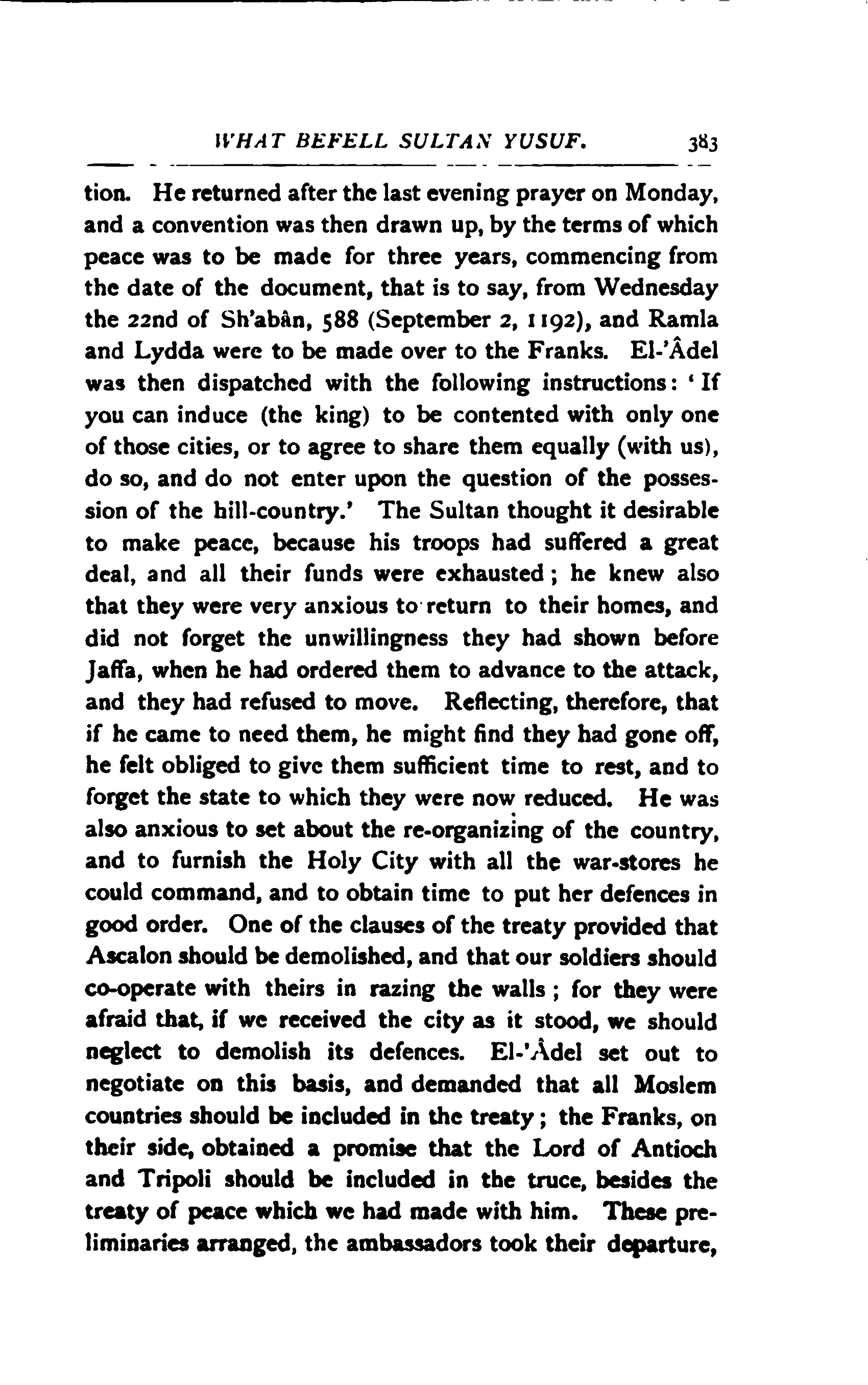
The provisions
The Franks retained their coastal possessions from Tyre to Jaffa. Jerusalem remained under Muslim government, and Christian pilgrims could visit its holy places. The works at Ascalon were to be demolished. Baha al-Din Ibn Shaddad reports a practical reason for joint demolition. Each side wanted assurance that the other could not occupy a ready-made fortress.
After the agreement
Some members of Richard’s army made the pilgrimage before sailing home. Richard left without visiting the city. It took another generation and a negotiation between Frederick II and al-Kamil of Egypt before most of Jerusalem changed hands. Their Treaty of Jaffa (1229) dealt separately with the city’s Muslim sanctuaries. The surviving narratives of 1192 describe a truce between rulers, with guarantees for movement and worship, rather than a permanent frontier settlement.
References
- Itinerarium peregrinorum, in Chronicles of the Crusades. Accessible English edition, 1882. The narrative of Richard’s expedition appears under the older attribution to Geoffrey of Vinsauf. See the sections on Cyprus and Acre.
- Baha al-Din Ibn Shaddad, The Life of Saladin. English edition of the Palestine Pilgrims’ Text Society (1897). See chapter CXVI on the captives, the chapters on the march to Arsuf, and the closing negotiations at Jaffa.
- Frederick II and al-Kamil, truce of 1229. The Crusades Regesta, RRR 2098. The register identifies both Arabic and Frankish narratives of the agreement.
Illustration. Palestine Pilgrims’ Text Society (1897). Original image and catalogue record. Public domain. Resized for display.
