 Knights Templar
Milling agreement at Tripoli
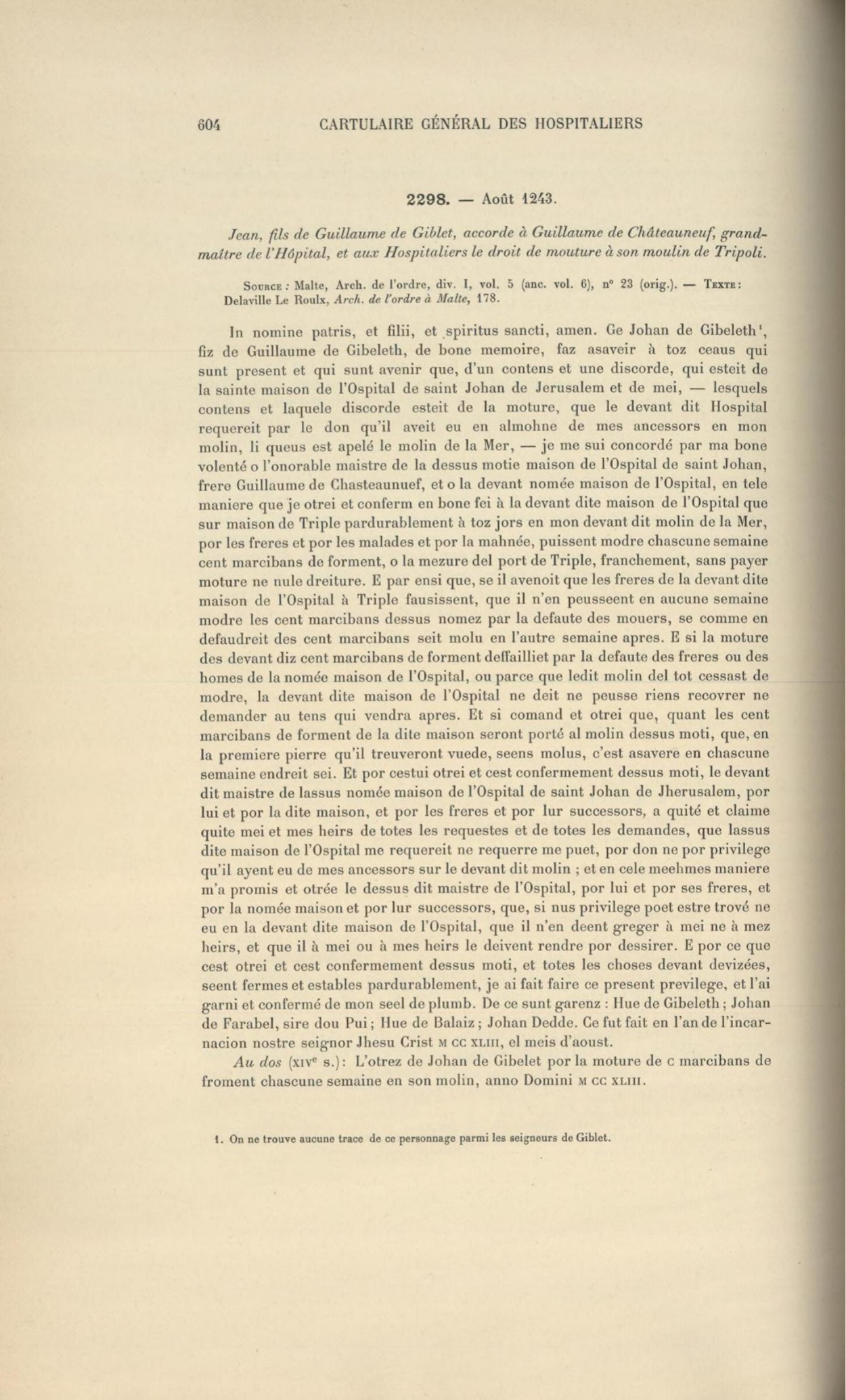
In August 1243 John of Gibelet agreed that the Knights Hospitaller could have wheat ground at his mill in Tripoli without paying the usual milling charge. The wheat was to supply the brothers, the sick and the household. The deed sets out what would happen when the order’s grain arrived at the mill.
The weekly allowance
John’s ancestors had already assigned milling rights to the Hospital, but the extent of the gift was in dispute. John and the master, William of Châteauneuf, settled on a weekly allowance of one hundred marcibans of wheat, reckoned by the measure of the port. The document uses a local unit without giving its equivalent in weight. The grain was to be ground on the first millstone that became free. A week’s unused entitlement could not be carried over to another week.
What John received in exchange
William released John and his heirs from earlier claims on the mill. If a conflicting privilege turned up in the Hospital’s archive, the brothers were to hand it over for cancellation. John authenticated his grant with a lead seal. Among the witnesses was John of Farabel, who had helped resolve the disagreement between the two military orders over their estates earlier that year.
References
- John of Gibelet, milling agreement with the Hospital, August 1243. Cartulaire général des Hospitaliers, II, no. 2298, p. 604. Old French text and later endorsement. The grant specifies the beneficiaries, weekly allowance, measure and witnesses.
- Boundary settlement between the Temple and the Hospital, May 1243. Old French text, Joseph Delaville Le Roulx, Cartulaire général de l’ordre des Hospitaliers, vol. II, no. 2296, pp. 602–603. The names of the arbitrators, the landmarks and Richard’s sealing clause appear on printed p. 603.

Illustration. Joseph Delaville Le Roulx, ed., Cartulaire général de l’ordre des Hospitaliers de Saint-Jean de Jérusalem, vol. II (1897). Original image and catalogue record. Public domain. Resized for display.
