 Knights Templar
Bertrand de Blanchefort’s letter on Antioch
In November 1164 the Templar master Bertrand de Blanchefort wrote to Louis VII of France about events in Egypt and Syria. He had two practical reasons for writing. The kingdom needed help, and a change of messenger meant that the brother whom Louis knew would not be bringing the news himself.
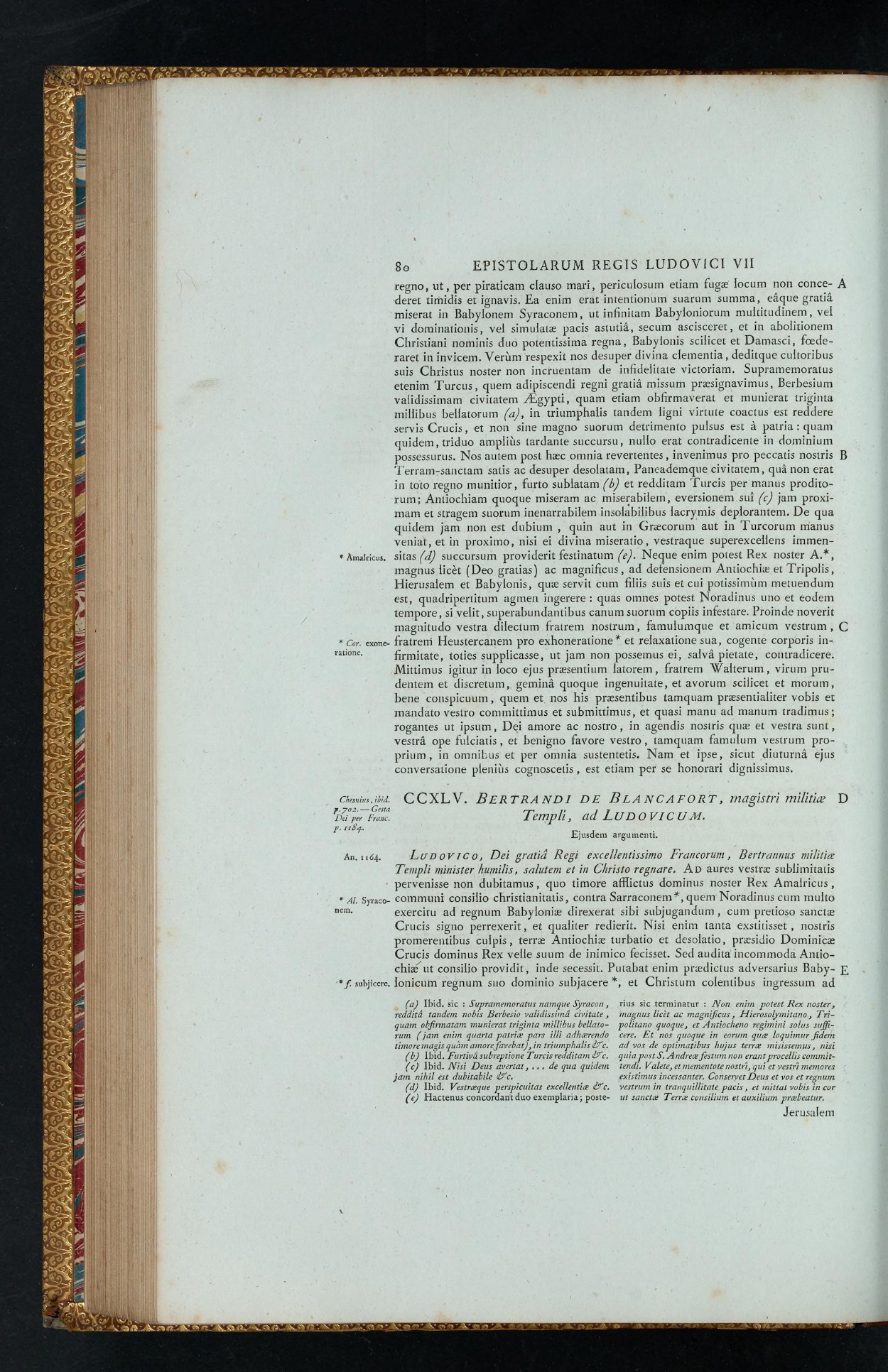
An army away in Egypt
Bertrand reminded the king that Amalric of Jerusalem had gone to Egypt, taking the relic of the True Cross. As the southern campaign ended, those who came home learned of the loss of Banias and the defeat of the army from Antioch at the Battle of Harim. Bertrand named the places the king of Jerusalem was being asked to defend. His appeal made a strategic argument about distance and available men, alongside its report of particular losses.
The messenger named in the letter
Near the end, Bertrand explained that Heustercanis was too ill to travel. He was therefore sending Walter. The change mattered because Louis had a personal connection with the absent brother. The written letter introduced Walter, who was to convey the master’s messages. Its preservation lets us identify both men, although it does not tell us what Walter said in the king’s presence.
References
- Bertrand de Blanchefort’s letter to Louis VII. November 1164. The Crusades Regesta, RRR 740, citing Recueil des historiens des Gaules et de la France, vol. 16, pp. 79–80, no. 244.
- Recueil des historiens des Gaules et de la France, volume 16. Latin text of Bertrand’s letter to Louis VII, pp. 79–80, no. 244.
- Ibn al-Athir, The Complete History, events of 559 AH. Recueil des historiens des croisades, Historiens orientaux, I, pp. 535–541, on Harim and Banias. The Arabic text and French translation appear together.
Illustration. Recueil des historiens des Gaules et de la France, XVI, p. 80. Original image and catalogue record. Public domain. Resized for display.
