 Knights Templar
Battle of Cresson
On 1 May 1187 a Muslim force in Galilee defeated a much smaller body drawn largely from the military orders. Roger de Moulins, master of the Knights Hospitaller, was killed. Gérard de Ridefort, master of the Temple, survived. The encounter took place in the country near Nazareth, two months before the Battle of Hattin.
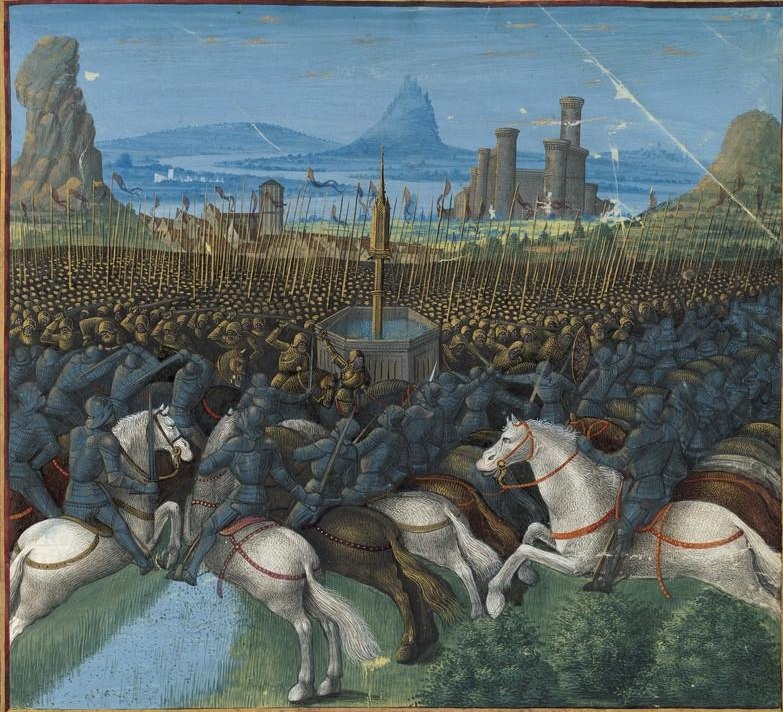
A divided kingdom
Guy of Lusignan had been crowned the previous year. Raymond III of Tripoli, one of the kingdom’s most powerful lords, had made a separate agreement with Saladin. The masters were in Galilee during attempts to reconcile king and count. When a Muslim column entered the region, the orders drew together men they could find locally. They met the column before the king had assembled the main army.
The loss of the two contingents
The early Latin account known as the Itinerarium peregrinorum names both masters and says explicitly that one escaped and the other died. It devotes more space to Jacques de Mailly, a Templar whose last stand the author interpreted as martyrdom, than to the disposition of either army. Its description of what the enemy thought of him belongs to that commemorative purpose. No secure count of all those present can be recovered from the figures it gives.
After Cresson
Raymond subsequently joined Guy’s army. The surviving Templars and Hospitallers also assembled for the summer campaign. At the Battle of Hattin they fought as part of the royal host. The deaths at Cresson had already deprived the Hospital of its master and both orders of men with long experience of the region.
References
- Itinerarium peregrinorum, book I, chapter 2. In Chronicles of the Crusades (1882), pp. 70–71. The account names the two masters and celebrates the death of a brother called Jakeline de Maillé.
- Itinerarium peregrinorum, in Chronicles of the Crusades. Accessible English edition, 1882. The narrative of Richard’s expedition appears under the older attribution to Geoffrey of Vinsauf. See the sections on Cyprus and Acre.
- The Battle of Hattin, 1187. Translated extracts from contemporary accounts of the campaign, including the use of Henry II’s funds and the treatment of prisoners.
Illustration. Sébastien Mamerot and Jean Colombe, Les passages d'outremer. Original image and catalogue record. Public domain. Resized for display.
